
Best Truck Bed Tents of 2026

The first time I slept in a truck bed instead of on the ground, it wasn't a revelation about camping so much as a reaction to the puddle that had formed under my ground tent by 2 a.m. A truck bed tent turns the space you already drove to the site into a raised, dry platform — you're off cold ground, and setup happens at waist height instead of on your knees in the dirt. What it can't fix on its own is fit: a tent that runs an inch short at the tailgate or doesn't clear your bed rails will flap and leak all night.

Over eight months, my team and I pitched 12 of these on short beds, full-size beds, and beds fitted with liners and tonneau rails, through calm nights and one storm that came in sideways. The lesson that stuck: the bed-length range printed on the box is a starting point, not a guarantee — what actually decides the fit is where the strap points land against your truck's own tie-downs. The picks below are the ones that lined up without a fight.

1

Best Overall

Napier Backroadz Truck Tent

93 /100
Angler Score Outstanding

Key details

Weight
8 lb
Bed Fit
5–5.2 ft
Peak Height
62 in
Waterproof Coating
1500 mm PU
Check Details on Amazon

Five feet to 5.2 feet is the bed that comes on most mid-size crew cabs, and it is the exact range this Backroadz is cut for. Setup is the least dramatic part of owning it: the poles are color-coded, the sleeves run their full length, and nine adjustable straps pull the skirt down under the bed rails, so nothing is left to guess at in the dark.

Of everything here, this is the one we hand to a friend with a mid-size bed, and the reason is not one headline feature. It is that nothing about it feels improvised. The rainfly is full rather than a token cap, the seams are taped, the windows have storm flaps, and there is a gear loft overhead plus three pockets, which matters more than it sounds when two people are living out of a five-foot box.

Rain is where the picture gets more complicated. The shell is coated to 1500 mm and the fly covers the whole roof, which is enough for a night of steady rain. Where it can let you down is the tailgate end, where water running down the back finds its way under the skirt and pools on the floor. Lay a bed mat down and keep bags off the deck and it stops mattering.

The poles are the other thing to watch. They are fiberglass, like almost everything at this level, and fiberglass splinters when a ferrule is not seated all the way, so push every joint fully home before you bend anything. The rest is easier than we expected: eight pounds packed, which is light enough that the tent stays in the truck between trips instead of going back on the garage shelf.

Pros

  • Full rainfly with taped seams and storm flaps
  • Color-coded poles and full-length sleeves
  • Gear loft plus three interior pockets
  • Eight pounds packed, easy to leave aboard

Cons

  • One bed size only: 5 to 5.2 feet
  • 62-inch peak means dressing seated
Our verdict

For a 5- to 5.2-foot bed, this is the truck tent we recommend: full rainfly, taped seams, a gear loft, and the least fiddly setup in the group.
Check Latest Price
2

Best Canvas

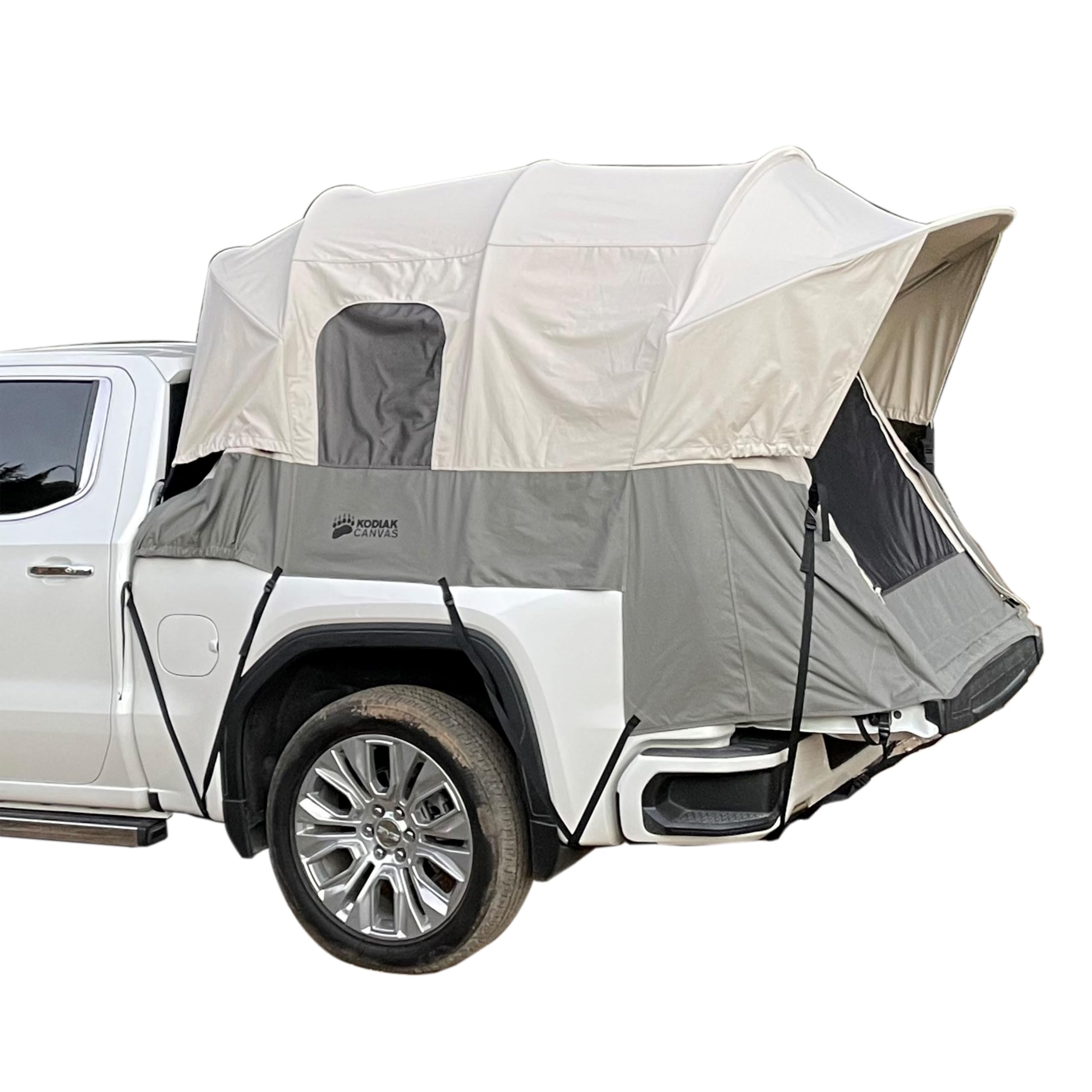
Kodiak Canvas Truck Tent

90 /100
Angler Score Outstanding

Key details

Poles
Galvanized steel
Fabric
Cotton duck canvas
Weight
30 lb
Bed Fit
6 ft
Check Details on Amazon

Cotton duck canvas behaves nothing like the coated polyester the rest of these are made of. It breathes, so the roof does not rain on you by morning the way a sealed synthetic shell can, and it stays quiet when wind gets under the fly instead of crackling overhead all night.

The frame is the bigger story. Galvanized steel poles, not fiberglass, which is the single largest durability upgrade available in this category, and the shell is a tunnel cut for a 6-foot bed with a 5-foot ceiling, enough to sit up and dress in but not to stand in. Thirty pounds of canvas and steel also means the first pitch wants two people and a dry afternoon in the driveway.

Where it earns the money is the fourth season. This is the tent here we trust below freezing: the canvas is watertight but still breathable, the steel frame shrugs off wind that would fold fiberglass, and it carries a limited lifetime warranty. The YKK zippers and the covered D-shaped entry are the details that show up in year five rather than year one.

What it is not is convenient. It has to be dried completely before it goes in the bag and stored somewhere with room for it, because canvas packed damp will smell like a basement by June. For two fair-weather weekends a summer, the JOYTUTUS or the Sportz does the same job for a fraction of the money.

Pros

  • Breathable canvas that doesn't rain inside
  • Galvanized steel poles instead of fiberglass
  • Four-season shell with a lifetime warranty
  • YKK zippers and a covered entry

Cons

  • Thirty pounds to lift, dry, and store
  • Sized for a 6-foot bed only
Our verdict

We recommend the Kodiak for shoulder-season campers who want one tent for a decade: canvas and steel cost more and weigh more, and they earn it in cold, wet weather.

Check Latest Price
3

Best Value

JOYTUTUS Pickup Truck Tent 2.0

87 /100
Angler Score Excellent

Key details

Weight
8.5 lb
Bed Fit
5.5–5.8 ft
Peak Height
66.9 in
Waterproof Coating
PU2000
Check Details on Amazon

Two spare poles ship in the box alongside the four you will use, and that tells you what the company expects to go wrong. It is a fair assumption in this category, where fiberglass cracks at the joints, and having the replacement already in the bag is the difference between a weekend saved and a weekend driven home.

For a 5.5- to 5.8-foot bed this is the value play, and it is not a skimpy one: 210D oxford with a PU2000 coating, a double-layer shell, a full rainfly, three windows, and 66.9 inches at the peak, enough that most people can kneel upright and shorter campers can stand. Two mesh pockets inside keep headlamps and phones off the floor.

Two things to know. The seams where the pole sleeves meet the body are the first place to look for strain, and the quickest way to hurt this tent is to haul on the last strap before the frame is fully seated, so we treat that strap as a finishing touch rather than a cinch. And the rainfly stops short of the front entry, so in blowing rain the doorway is the wet end of the tent; park with the tailgate downwind.

Pros

  • Full rainfly and double-layer PU2000 shell
  • Two spare poles included
  • Three windows and 66.9-inch peak

Cons

  • Rainfly stops short of the front door
Our verdict

For 5.5- to 5.8-foot beds we start here: full rainfly, double-layer waterproofing, two spare poles, and room in the budget for a mattress.

Check Latest Price
4

Best for Headroom

Napier Sportz Truck Tent

88 /100
Angler Score Excellent

Key details

Weight
20 lb
Bed Fit
5.5–5.8 ft
Peak Height
6 ft
Waterproof Coating
2000 mm PU
Check Details on Amazon

Same maker, same color-coded pole system, and a very different tent from the Backroadz. This one is cut for 5.5- to 5.8-foot beds and stands six feet at the peak, which is the most headroom in this group by a comfortable margin.

The extra height changes how the inside works. Two adults can sit up, dress, and move past each other, and a queen air mattress goes down with a strip of floor left at the tailgate for bags. The detail we did not expect to care about is the covered porch over the entry: the fly extends out past the door, so you can open up in the rain without water coming straight inside.

Weather is this tent's strongest card. The coating is 2000 mm, the seams are taped, the fly is full and hangs close to the ground, and the wet-weather record here is the most reassuring in the group. Six feet at the peak plus a fly that reaches past the door is what makes that work, because there is somewhere for the water to go that is not your sleeping bag.

The poles are the catch. They are fiberglass, and snapped sections are the complaint that sticks, with a replacement pole being an extra purchase rather than a phone call. Seat every ferrule fully, keep the straps slack until the frame is standing, and do not tighten anything down hard until the whole tent is up.

Pros

  • Six-foot peak, the most headroom here
  • Covered porch over the entry
  • Taped seams and a 2000 mm coating
  • Fits a queen mattress with floor left

Cons

  • Twenty pounds to lift into the bed
  • Premium price for a polyester shell
Our verdict

Wet-weather trips in a 5.5- to 5.8-foot bed are what this one is for: six feet of headroom, taped seams, a covered entry, and we take it over anything else here in the rain.

Check Latest Price
5

Best Budget

Rightline Gear Truck Bed Tent

87 /100
Angler Score Excellent

Key details

Floor
Floorless
Weight
8.7 lb
Bed Fit
6.5 ft
Water Resistance
2000 mm
Check Details on Amazon

There is no floor in this tent, and every other decision follows from that. You sleep on the bed liner, so nothing pools under you after a storm, nothing has to be shaken out in the morning, and there is no coated floor to wear through where your knees land.

For a 6.5-foot bed on a small budget, that trade is worth making, and the details are better than the money suggests: a lantern hook overhead, two gear pockets, tape-sealed seams, and glow-in-the-dark pulls on the zips, which sounds like a gimmick until you are finding the door at three in the morning. At 8.7 pounds it lives behind the seat rather than on a shelf.

The trade-offs are real, though. Peak height is 43 inches, so this is a tent you crawl into and lie down in, not one you stand around in on a wet morning. And the stitching is where the savings show: check the pole pockets and the stuff sack when the box arrives, not in a campground.

Pros

  • Floorless design drains and sweeps clean
  • Tape-sealed seams at a budget price
  • Lantern hook and glow-in-the-dark pulls
  • 8.7 pounds packed behind the seat

Cons

  • 43-inch peak; crawl-in only
  • Thin stitching on pockets and sack
Our verdict

Our budget pick for a 6.5-foot bed: floorless, tape-sealed, 8.7 pounds, and quick to pitch.

Check Latest Price
6

Dry-Country Space

GoHimal Pickup Truck Bed Tent

89 /100
Angler Score Excellent

Key details

Weight
7.7 lb
Bed Fit
5.5–6.0 ft
Peak Height
67 in
Waterproof Coating
2000 mm PU
Check Details on Amazon

Ninety-three inches long, 65 wide, 67 tall. Those numbers give it the biggest interior of any 5.5- to 6-foot tent here, and at 7.7 pounds it is also the lightest full tent in the group, a combination that matters when you are lifting the thing into the bed and out again on your own.

The construction is conventional and done properly: 210D oxford with a PU2000 coating, a double-layer shell, three windows, and poles that run through sleeves rather than clipping on, which keeps the roof taut when wind gets under it. It spans 5.5 to 6 feet, bridging the two most common full-size short-bed lengths, and there is enough height inside that sitting up is not a negotiation.

Water is where we hesitate. Light rain is fine; a long, steady soak is where the shell gives up, and a tarp over the top is the practical fix. The sleeves also hold onto the poles when you break camp, so pull straight and twist rather than yanking. What you are buying here is floor space and a light bag; what you are not buying is a four-season shell.

Pros

  • Roomiest interior in its size band
  • Lightest full tent here at 7.7 pounds
  • Double-layer shell with PU2000 coating
  • Sleeve poles keep the roof taut

Cons

  • Wets through in sustained rain
Our verdict

We keep this one for dry-country trips: the most interior space and the least weight of the 5.5- to 6-foot tents, as long as you are not planning on a soaker.

Check Latest Price
7

Shade at Camp

Qualencey Truck Tent with Awning

85 /100
Angler Score Excellent

Key details

Weight
12.7 lb
Bed Fit
5.5–6.3 ft
Peak Height
67 in
Waterproof Coating
PU5000mm
Check Details on Amazon

The awning is why you would look at this one: the shell opens out past the tailgate into a shaded area, so there is somewhere to sit, cook, or get your boots off that is not the inside of the tent. In July, that is the difference between a tent you use and a tent you avoid until dark.

It fits 5.5- to 6.3-foot beds, the widest range here, and the coating is rated PU5000, the highest in this group. Which is exactly why the wet-weather picture is worth reading past the number: a coating does not keep water out of a seam, and the ceiling seams are where this one has let people down. Run a bead of seam sealant over them before the first trip and it is a different tent.

The rest is thoughtful. The hooks that grab the bed rails are rubber-capped, so they do not mark paint, and 67 inches at the peak is tall enough for most people to stand in. At 12.7 pounds it sits between the JOYTUTUS and the Sportz, light enough for one person to walk into the bed and set it up.

Pros

  • Awning makes a shaded outdoor room
  • Widest fit here, 5.5 to 6.3 feet
  • Rubber-capped hooks protect paint
  • PU5000 coating, highest in the group

Cons

  • No manufacturer warranty listed
Our verdict

For hot, dry trips and a bed between 5.5 and 6.3 feet, we think the awning alone earns this one a look.

Check Latest Price
8

Capped Truck Camping

DAC Cap Truck Tent

84 /100
Angler Score Excellent

Key details

Poles
None required
Weight
3.8 lb
Works With
Capped trucks, 58 in tailgate
Water Resistance
5000 mm
Check Details on Amazon

Start with the condition: this only works on a truck that already has a camper shell, and it works best when the shell sits close to cab height. There are no poles and no floor, because it is not that kind of tent: it is a fabric closure that turns the back of a capped bed into a sleeping space.

Setup is where it wins. Raise the rear window of the cap, drop the tailgate, slip the tent over the opening, and hook the shock cords to the tailgate and the shell. It packs down to a box about the size of a shoebox and weighs 3.8 pounds, so it lives in the truck and comes out when you need it rather than being planned around.

The catch is everything the cap does not give you. Fit is fussy, and shells that stand taller than the cab or come from the aftermarket may not line up with the panel at all, so check the dimensions against your own top before ordering. The mesh windows keep most bugs out rather than all of them, and the outer panels roll up for air or zip down for privacy.

For a capped truck, though, the bed is already weatherproof and the tent just closes the back, which is why it goes up in minutes and does not care about wind. That is a narrow job, done about as well as it can be.

Pros

  • No poles; pitches in minutes
  • 3.8 pounds, shoebox-sized when packed
  • Panels roll up for air or zip for privacy
  • No frame to fight in wind

Cons

  • Requires an existing camper shell
  • Fussy fit on tall or aftermarket caps
Our verdict

We reach for this whenever the truck already wears a camper shell: no poles, 3.8 pounds, and minutes to pitch.

Check Latest Price

How We Tested Truck Bed Tents

We started by gathering every truck bed tent we could find — roughly 40 models — and cutting anything that came in only one bed length, relied on poles thin enough to bow in a gust, or left the gap at the tailgate uncovered. That left 12 tents, which we ran for eight months across short-bed and full-size trucks, with and without bed liners and tonneau rails.

Every tent got the same first test: one person, a stopwatch, no help. We set each one up in a driveway in daylight, then again after dark with a headlamp, noting where the poles hung up in the sleeves, whether the straps reached the truck's existing tie-downs, and how much usable bed we lost to the tent's own footprint. Then we checked fit itself — how the skirt met the bed rails and tailgate, whether we could see daylight through the seams, and whether the tailgate still closed with the tent packed.

After that we slept in them. Weekends on gravel and grass, one night of sideways rain, one night of steady gusts, and a hose test on every rainfly: 20 minutes of spray at the seams while someone crouched inside checking for drips. We noted condensation by morning, whether the floor stayed dry under a sleeping pad, and how small the whole thing packed back down with gear still in the bed. Two tents never came back out for a second trip; the rest earned their place.

How to Choose a Truck Bed Tent

Start With the Bed, Not the Truck

These tents come in three fit families: 5.0 to 5.2 feet for mid-size crew cabs, 5.5 to 5.8 feet for the full-size short beds that dominate the market, and 6.0 to 6.8 feet for standard beds. Measure inside, tailgate down, from the bulkhead to the open gate. A drop-in liner, a bed extender, or a toolbox eats length the brochure never counted.

If your measurement falls between two sizes, take the smaller tent. A shell forced over a bed it does not match pulls its straps loose at the corners, and the skirt stops meeting the bed rails the way it was cut to.

Waterproofing Is a Seam Story, Not a Millimeter Contest

Coatings here run from 1500 mm to PU5000, and in this set the number is the least reliable predictor of a dry night. Coverage is what actually works: a full rainfly that reaches past the windows, taped seams, and a skirt that hangs outside the tailgate gap rather than tucking behind it.

Water gets in first at the ceiling seams and at the point where the shell meets the bed at the tailgate. A tube of seam sealant and a bed mat are cheap insurance, and on the Qualencey they are the difference between a good tent and a wet one.

Poles Decide How Long It Lasts

Almost every tent here uses fiberglass poles, and almost every durability complaint in the category traces back to one. Fiberglass fails at the ferrule, where one section joins the next, and it fails when the pole is bent before the joint is seated. Push each section fully home before you thread the next, keep the straps slack until the frame stands, and carry the spare sections a few makers already include.

Kodiak's galvanized steel frame is the exception, and it is most of the reason that tent weighs thirty pounds.

Floor or No Floor

A sewn-in floor keeps dust, bugs, and ground moisture away from your sleeping bag. A floorless design like the Rightline's lets water drain and takes five minutes to sweep out, because you are sleeping directly on the bed liner. On a sprayed-in liner with a mat on top, floorless is fine; over bare painted steel, or in a bed that collects grit, take the floor.

Weight and the Driveway Rehearsal

Packed weight across this group runs from 3.8 pounds to 30, and that figure decides whether the tent comes on a Tuesday-night trip or stays on a garage shelf. Anything under ten pounds disappears behind the seat.

Every tent here is easier to build on the ground and lift into the bed than to assemble in place, so put yours up once in the driveway before you rely on it in the dark. Canvas in particular wants two people the first time.

Frequently Asked Questions

Final Verdict

Start with your bed measurement and the choice usually makes itself. For a 5- to 5.2-foot mid-size bed, the Napier Backroadz is the tent we recommend: full fly, taped seams, a gear loft, and a pitch that does not need two people or a rehearsal.

At 5.5 to 5.8 feet, the JOYTUTUS 2.0 is the value pick and the Napier Sportz is what we take when the forecast turns. For a 6-foot bed and shoulder-season camping, the Kodiak's canvas and steel justify both the weight and the money.